Twelve questions to ask before you buy HSE...
Read More
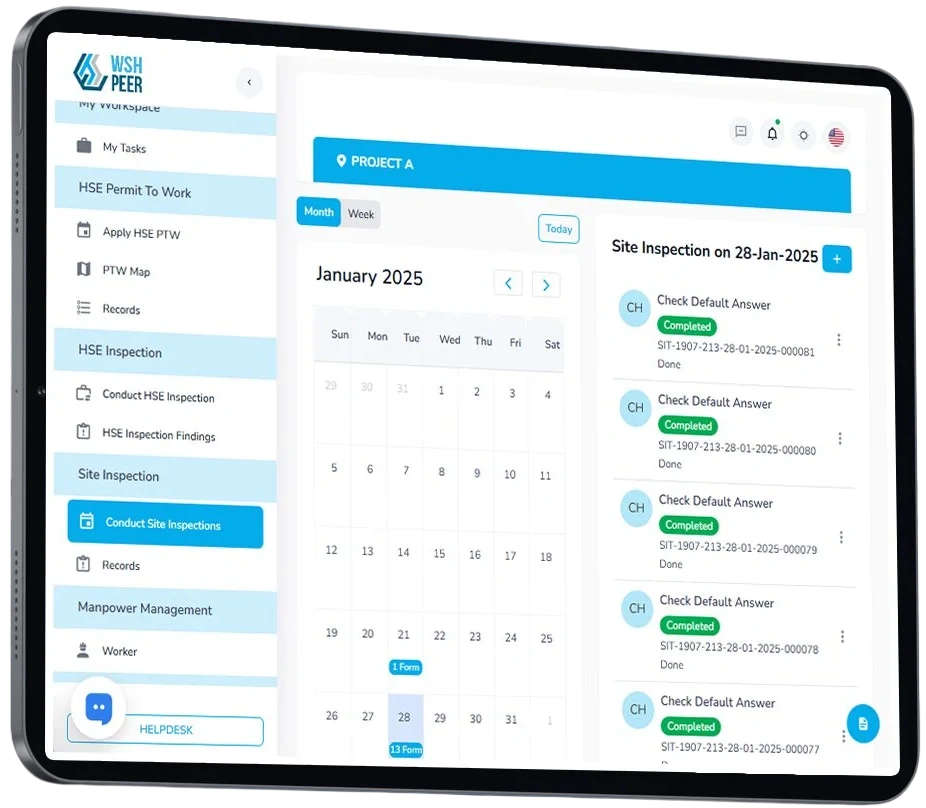
PEER runs permits to work, equipment checklists and RE/RTO inspections for Singapore construction every record tied to a block, a level and a grid reference, signed and timestamped the moment it’s raised.
















Don’t miss the latest promotion from PEER. Take advantage of exclusive offers to help your company digitize OHS inspection processes, accelerate follow-up on findings, and boost operational efficiency. Limited time only—make sure you don’t miss out.
Who runs PEER
A construction site has a main con who is accountable, subcons who do the work, and consultants who verify it. Most safety apps only serve one of them. PEER puts all three in the same record.
Main contractors
You carry the liability for work you didn’t perform. PEER gives you a live view of every permit and every open finding, by subcontractor.
Specialist subcontractors
RE & RTO teams
Structured RE and RTO inspection cycles, Chief RE approval, and follow-up actions that don’t disappear between site visits.
Why paper fails on a construction site
A form has to survive a site, a van, a WhatsApp group and a filing cabinet before anyone can use it.
On a project with fifteen subcontractors, that’s fifteen chances to lose it.
01 / Repeat
A hazard gets raised, someone fixes it, nobody records the closure. Next inspection it’s back on the floor above, with no history to prove it ever happened.
02 / Retrieval
The permit is real — in a folder in the site office, or a photo in a chat thread. An inspector standing on your site today doesn’t accept “by Friday”.
03 / Subcon chain
Nothing is comparable, nothing rolls up, and nobody can say which trade is actually closing their corrective actions.
04 / Location
A finding without a grid reference is a finding the next shift can’t act on. Vague location is the most common reason a corrective action stalls.
05 / Clashes
Hot works above, confined space entry below. On paper permits, nobody sees the overlap until something happens.
06 / Language
Sign-off happens because someone was told to sign, not because they understood the hazard they were signing off on.
Built on site structure
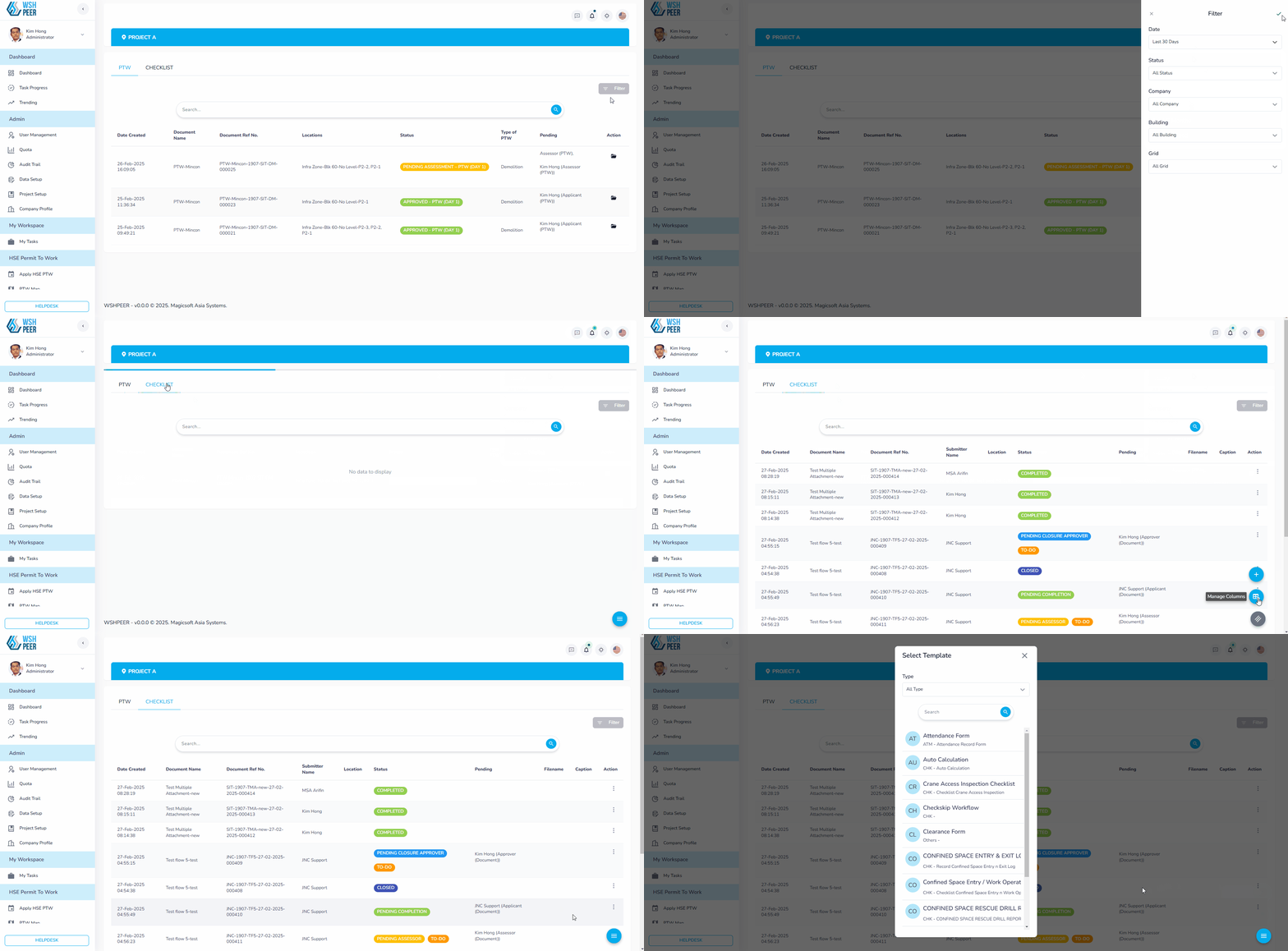
Generic safety apps attach a finding to a project. That’s useless on a job with four blocks and twelve levels. PEER addresses down to the individual structural element, so the next person knows exactly where to stand.
Set your project hierarchy once during onboarding. Every permit, checklist, finding and photo inherits it from then on — which is also what makes an audit export usable rather than a pile of PDFs.
High-risk work
Templates you can use as-is or edit. If you already have a form that works,
dynamic forms mean you’re not rebuilding your process around software.
Daily rig checks, ground stability, exclusion zones.
Daily lifting checklist, LM and LSO appointments, RA prerequisites.
MEWP pre-use checks for boom and scissor lifts, anchor points, edge protection.
Erection, alteration and dismantling checks with inspector sign-off.
Permit with fire watch, gas testing and adjacent-work checks.
Entry permit, atmospheric testing records, standby person.
Sequence checks, prerequisite documents, workforce count.
Shoring, access, adjacent services and daily plant checks.
Built for how Singapore construction works
PEER was built here, for sites here. That shows up in the details most platforms skip.
Site staff log in with Singpass. Identity verified, no shared accounts, instant offboarding when someone leaves the project.
The Construction Safety Audit Scoring System is construction-specific — and PEER’s records are structured to meet its requirements
Every edit, approval and signature logged with a user and timestamp. Nothing can be backdated after an incident.
Pending approvals and overdue actions reach supervisors where they already are. No new app for the crew to install
Tenant registration brings each subcon in with their own scope and users — not a shared login passed around the site office.
Run several sites from one account. Switch projects without logging out or losing your task list.
The platform
Guided walkthroughs of the real product. No form, no sales call.
Tell us how we’re doing and help us serve you better
oke
An HSE (Health, Safety, and Environment) inspection application is a digital system designed to help companies conduct workplace health and safety inspections faster, more systematically, and with better documentation. By using an HSE inspection application, companies can replace paper checklists and spreadsheets with a much more efficient digital workflow.
Using an HSE inspection application helps companies:
Reduce inspection time
Eliminate duplicate data entry
Track corrective actions in real-time
Simplify audit preparation
Centralize all inspection data on a single platform
This makes the entire inspection process significantly more efficient and easier to monitor.
Yes. PEER is designed to support a wide range of industries, including construction, manufacturing, mining, oil & gas, logistics, facility management, and any other sector requiring digital HSE inspection processes.
Yes. PEER is a fully responsive, web-based platform. You can seamlessly access it from smartphones, tablets, laptops, or desktop computers without needing to install a separate mobile app.
Yes. You can sign up for a PEER Free Trial to explore features like Digital Inspection, Corrective Action Tracking, the Dashboard, and other modules before deciding on a full implementation.
Safety inspections are essential for preventing workplace incidents,...
Read MoreManaging workplace safety becomes significantly more complex when...
Read MoreThe construction industry in Singapore operates under some...
Read More
Thirty minutes, your forms, your project hierarchy. We’ll show you exactly what changes and what doesn’t — no generic script.